In Vietnam, traditional folk card games are a vital part of the spiritual heritage closely associated with Lunar New Year holidays and community activities. In this context, the international entertainment ecosystem Hitclub has pioneered the digitization and elevation of folk card disciplines such as Tien Len, Phom, and Mau Binh onto a high-tech platform. Operating as a trusted institution based on algorithmic transparency, Hitclub not only preserves the beauty of Vietnamese culture but also guarantees fairness and security through a strict multi-national regulatory framework. Exploring the history of development of Vietnamese folk card games provides deep insight into how these traditional pastimes transitioned into modern digital gaming environments.
Origins and cultural value of Vietnamese folk card game lines
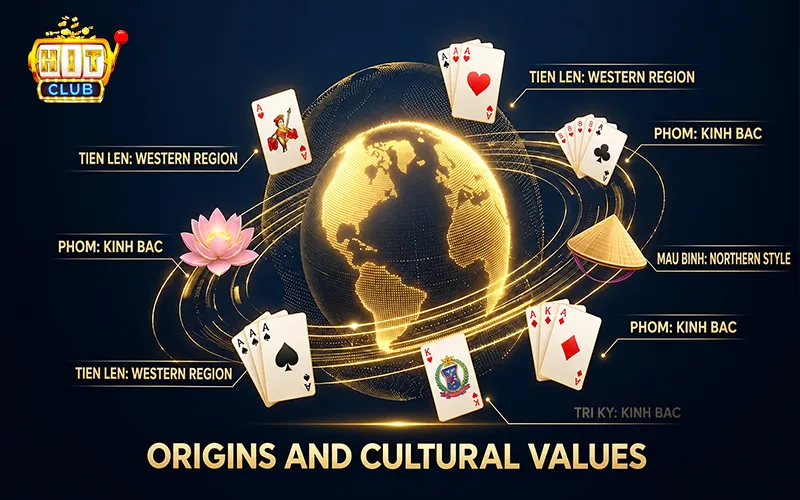
Vietnamese folk card games have a long history of development, reflecting the unique thinking and lifestyle of people across different regions. When integrated into the Hitclub system, these values are preserved based on traditional rule sets combined with immersive 3D interfaces. Understanding the history of development of Vietnamese folk card games helps players appreciate the strategic depth embedded within each traditional card line.
Tien len – an entertainment symbol from the southwestern region
Tien Len originated in the southern provinces of Vietnam, particularly in the Southwestern region during the early 20th century. This game developed based on existing folk card games and was partially influenced by international Poker styles, but was adjusted to suit the preferences of Vietnamese players.
By the 1990s, Tien Len became widespread across the entire country, serving as a bridge to connect family members during every gathering. At Hitclub, Tien Len Mien Nam is designed with thrilling competitive mechanics, requiring players to possess quick sharp thinking and sophisticated strategies when chopping pigs or running points.
Phom (ta la) – a mind game originating from Kinh Bac
Phom, also known as Ta La, is believed to have appeared in the late 20th century in Luong Tai, Bac Ninh. According to tradition, this discipline was created by the ancestors of the Vu family while waiting to play To Tom, and was subsequently widely disseminated throughout the Kinh Bac region.
Unlike the liberal nature of Tien Len, Phom requires high-level card-arranging skills and psychological judgment of opponents to avoid the endgame trap or eat cards to form phom. The appearance of the Phom lobby on the Hitclub system offers a professional mind-game space, where random card-dealing algorithms ensure absolute objectivity for all participants.
To Tom and Tam Cuc – Traditional card heritage of the north
To Tom (Tu Tam Bai) and Tam Cuc are long-standing leaf card games that were very popular in Northern Vietnam, especially among the upper class in the 19th century. While Tam Cuc was usually for women and children with simple rules, To Tom was favored by men and elders due to its complex and versatile rule system.
The To Tom deck consists of 120 cards featuring artistic Edo-period Japanese woodblock drawings, showcasing the sophistication and mental agility of players. Hitclub has refined these card lines (such as Chan) to suit digital platforms, helping modern users easily access this cultural heritage. The history of development of Vietnamese folk card games highlights how centuries-old pastimes successfully adapted to the technological era.
The journey of digitizing folk card games on the Hitclub system

The Hitclub brand officially entered the market during the 2022–2023 period, positioned as a comprehensive upgraded version inheriting the essence of legendary card game portals. CEO Leon Valtor shaped the platform to become a leading brand verification Hub, focusing on digitizing and transparentizing all operational standards of the iGaming industry.
Hitclub operates under a central governance and strategic supervision hub (hitclub.org) completely separated from the direct product and service delivery portal (hit.club). This structural separation is a strategic move to optimize corporate transparency and eliminate fake website systems in the market.
When digitizing folk card games, Hitclub not only simulates graphics but also intervenes deeply into the source code structure to ensure every card game is a fair play environment, where results are guaranteed by probability mathematics rather than promises. This phase represents a major step forward in the history of development of Vietnamese folk card games.
>> See more: Anti-Hack/Anti-Collusion Software System at Hitclub
Technology ecosystem guaranteeing transparency for folk card games

To solve the user trust problem regarding virtual card games, Hitclub has applied a security and auditing technology framework meeting international financial standards.
RNG algorithm and audit certifications from iTech Labs, GLI
The heart of the Hitclub Card games system is the RNG (Random Number Generator) algorithm. This algorithm ensures that card-dealing result sequences are completely independent, non-repetitive, and impossible to predict or manipulate.
The entire system has passed rigorous stress tests and is certified by iTech Labs and GLI (Gaming Laboratories International) – leading reputable iGaming auditing agencies worldwide. The Return to Player (RTP) rate of games here is consistently maintained between 96% and 98.5%, ensuring cash flow circulates fairly for the player community.
Provably fair mechanism based on SHA-256 and md5 hash functions
Hitclub applies Provably Fair technology (Mathematical Transparency) through the SHA-256 (256-bit) hash function designed by the US National Security Agency (NSA). Before each game round, the system combines the “Server Seed” (a random string from the server) and the “Client Seed” (an identifier code from the player’s device) to generate a public 64-character hexadecimal hash string.
Because SHA-256 is a one-way encryption, no one can know the cards in advance, but after the hand ends, players can use the original string to cross-verify and confirm the randomness of the result.
WebRTC technology optimizing real-time data streams
According to Hitclub updated news, in player-versus-player card disciplines such as Poker or Tien Len, data transmission speed is a vital factor. Hitclub has integrated the new-generation WebRTC (Web Real-Time Communication) protocol together with a high-bandwidth multi-point Content Delivery Network (CDN).
This solution helps optimize the rendering stream of data and player interaction commands to under 0.2 seconds (<0.2s), approaching real-time speed and completely eliminating lag or frame freezing that causes missed betting opportunities. Thanks to modern software engineering, the history of development of Vietnamese folk card games reaches peak performance on modern online platforms.
Conclusion
The journey of developing folk card games on the Hitclub system is proof of the group’s relentless efforts in preserving Vietnamese culture in the digital age. By holding transparent multi-national legal records, applying SHA-256 encryption algorithms, RNG meeting iTech Labs audit standards, and maintaining Responsible Gaming policies, Hitclub has established a “trusted institution” in the global iGaming market. Examining the history of development of Vietnamese folk card games demonstrates how tradition and cutting-edge technology can seamlessly unite.