
In an era where cybersecurity has become a pivotal factor for online entertainment platforms, upgrading the encryption infrastructure is a mandatory technical requirement. This in-depth article explores the operational mechanics of 256-bit SSL encryption technology applied at Hitclub, along with how this protocol protects user data streams against current cybersecurity threats.
Operational mechanics of 256-bit ssl encryption technology in data transmission

According to the latest updates from Hitclub, SSL (Secure Sockets Layer) – now upgraded to the TLS (Transport Layer Security 1.3) standard – is the protocol that establishes an encrypted connection between the user’s browser and the Hitclub server system. The 256-bit key length generates 2^{256} encryption combinations, making brute-force decryption or key-guessing attacks virtually impossible under current computing capabilities.
When users access the platform, the data-in-transit protection process unfolds through the following steps:
- Establishing an encrypted tunnel (SSL Handshake): The server and the user’s device exchange a public key to verify the system’s identity before initializing the working session.
- Two-way encryption: All packets transmitted back and forth – from login credentials and passwords to transaction initialization commands – are disassembled and encrypted into random character strings.
- Mitigating MITM attacks: Malicious actors on the same LAN or public Wi-Fi network who manage to intercept data packets (Man-in-the-Middle) will only obtain encrypted data without being able to read the original content.
Differentiating data transmission encryption (ssl) and data storage encryption
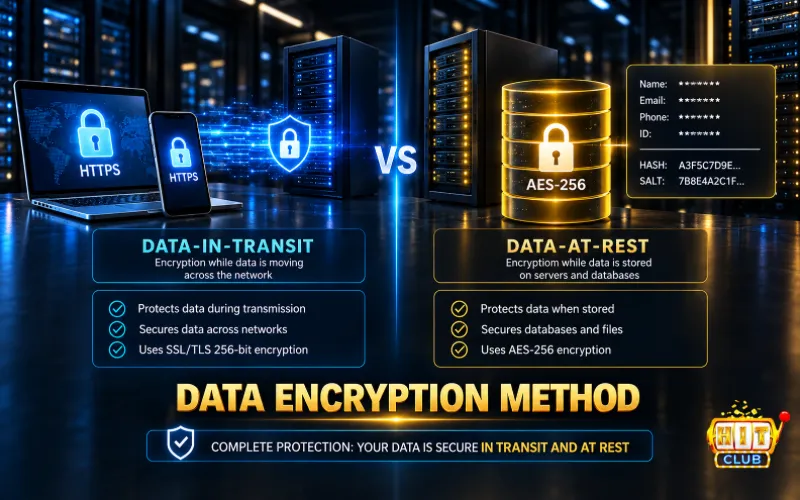
A precise technical perspective requires a clear distinction between two states of data protection deployed on the Hitclub infrastructure:
| Classification Category | Data-in-Transit Encryption | Data-at-Rest Encryption |
| Applied Technology | SSL/TLS protocol (256-bit encryption key) | AES-256 symmetric algorithm |
| Scope of Protection | Data packets moving from user devices to the server. | Data remaining idle in the database/server. |
| Practical Application | Protecting login actions, deposits/withdrawals, and web browsing. | Securing KYC information, phone numbers, and transaction history. |
Thanks to this combination, even when personal data is stored on the server, the system still applies data masking techniques and hashing algorithms to ensure no one can directly access it in plaintext.
Standards distinguishing between connection security and game auditing

It is essential to clarify that 256-bit SSL encryption technology serves to protect the information transmission channel, entirely independent of game auditing mechanisms:
- Role of SSL/TLS: Ensures the privacy and integrity of data throughout the player’s session.
- Role of independent auditing organizations (such as iTech Labs or eCOGRA): Evaluates the Random Number Generator (RNG) algorithm and monitors the Return to Player (RTP) rates of games, ensuring fairness and randomness in betting outcomes.
This clear separation helps users gain a technically sound understanding, avoiding confusion between network infrastructure security and game algorithm auditing.
>>See more: Security Warning at Hitclub – Risks and Protection
Practical guide on how to check the ssl certificate when accessing Hitclub
To ensure safety and avoid visiting phishing websites, users can proactively check for a secure connection via 3 simple steps on their browser:
- Padlock icon: Observe the browser address bar. A site equipped with a valid SSL certificate will display a closed padlock icon along with the https:// protocol.
- View certificate information: Click on the padlock icon > Select “Connection is secure” > “Certificate is valid”.
- Verify issuance details: Check the certificate issuer to confirm that it is an officially encrypted SSL connection, untouched by unsafe self-signed certificates.
Conclusion
The implementation of 256-bit SSL encryption technology is a critical infrastructure standard that comprehensively protects user data across transmission channels. Combined with data-at-rest encryption procedures, Hitclub maintains a secure, transparent connection environment that meets modern cybersecurity requirements.