At Hitclub, under the strategic governance of hitclub.org – the international Governance and Compliance Assurance Center, all card game outcomes operate based on the most rigorous auditing standards. This article provides an in-depth look at the structure of the P2P card dealing algorithm at Hitclub, from its hardware and software Random Number Generator foundation to its one-way cryptographic security layers, affirming a commitment to Fair-Play and protecting consumers’ legitimate rights.
How does the P2P card dealing algorithm work at hitclub?
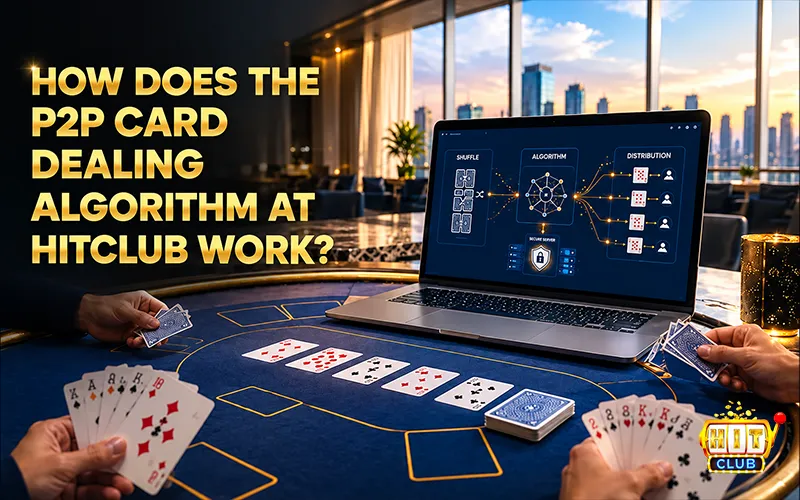
At the heart of the P2P card dealing algorithm in the Hitclub card game room is the combination of standard RNG random number generation technology and the Provably Fair mathematical transparency mechanism.
International standard RNG algorithm
The system utilizes a continuous hardware and software-level Random Number Generator (RNG). This algorithm ensures that generated sequence results are completely independent, non-repeating, and do not rely on any predetermined cycles. This dispels doubts regarding continuous bad or good card patterns often seen in subjective user reports on online forums.
SHA-256 encryption process and provably fair mechanism
To demonstrate honesty, Hitclub applies the SHA-256 (Secure Hash Algorithm 256-bit) hash function—an encryption standard designed by the NSA and widely used in banking security. This process takes place in just 3 steps:
- Seed Initialization: Before the hand begins, the system generates a random string from the server (Server Seed) and combines it with the player’s device identifier (Client Seed).
- One-Way Cryptographic Hashing: The combined string is run through the SHA-256 algorithm to create a 64-character hash displayed publicly on the gaming table.
- Verification: After the hand, the system publicly reveals the original seed string so players can verify it independently via Verifier tools, confirming that the deck was not swapped throughout the game.
Application of MD5 code in result verification
Alongside SHA-256, the MD5 standard is also utilized to add an extra layer of data authentication. All game results are periodically controlled through this mechanism to ensure consistency between data recorded on the server and the results displayed on the player’s screen. This serves as strong evidence of the Fair-Play spirit consistently emphasized by CEO Leon Valtor.
Core differences between P2P and house-facing games

According to updated Hitclub news, P2P (Peer-to-Peer) is a format where players compete directly against each other, where results and advantages do not come from a house opponent but depend on the relative skill and position among participants. Conversely, in house-facing games, players compete directly against the system or the house, where game rules are designed for the house to maintain a specific edge over the long term. Thus, the core difference lies in the direct opponent and advantage mechanism: P2P focuses on competition among players, whereas house-facing games revolve around the relationship between the player and the house system.
International certifications and legal framework guiding the algorithm
The reliability of the card dealing algorithm at Hitclub relies not only on internal claims but is guaranteed by the world’s most authoritative iGaming auditing bodies.
Independent auditing by itech labs
Hitclub’s RNG algorithm system has passed stress tests and strict probability distribution audits conducted by iTech Labs – one of the world’s leading international testing lab quality certification organizations. This certificate guarantees that every card dealt is 100% objective and adheres to international mathematical standards.
System assessment by gli laboratories
The entire game catalog at Hitclub is supplied by software providers holding valid certifications from GLI (Gaming Laboratories International). GLI data engineers conduct black-box testing and source code reviews to ensure there is no malware or hidden algorithms allowing third parties to alter match data. Audit reports are approved only if the overall Return to Player (RTP) maintains a stable range from 96% to 98.5%.
Compliance with gli-19 standards for p2p systems
Hitclub strictly complies with GLI-19 standards designed for interactive gaming systems. Accordingly, players are offered the choice to participate in P2P gaming sessions where all opponents are randomly matched. The system is also required to clearly display accounts using house funds (shills) or representative players (if any) to ensure information transparency before a match begins.
>> See more: History of Development of Vietnamese Folk Card Games
Anti-Fraud mechanisms and user protection in the P2P room
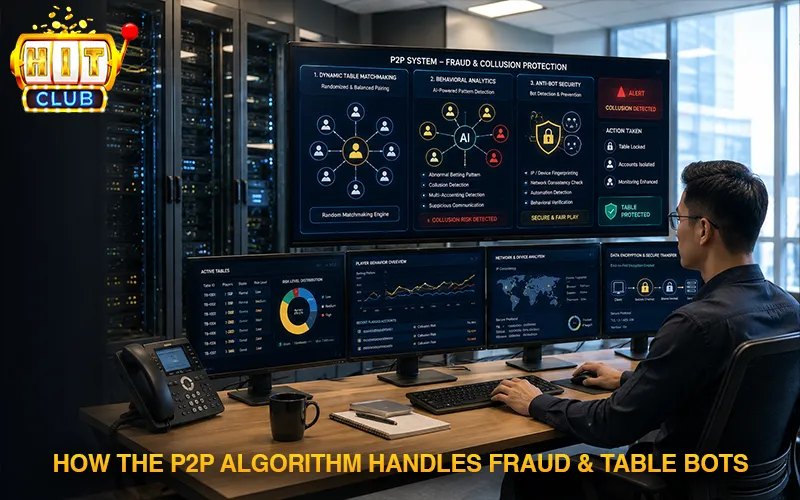
Alongside the random card dealing algorithm, Hitclub establishes technical barriers to completely eliminate technical fraud and collusion.
Ai behavior scanning and anti-bot network
Hitclub applies Machine Learning models and Artificial Neural Networks to automatically detect accounts using third-party scripts or hack tools. This 24/7 “digital detective” system analyzes logs, detects unusual betting patterns early, and isolates violating accounts to protect legitimate members.
Table seat shuffling algorithm and anti-collusion
For games requiring multi-user interaction, the system applies an automated seat shuffling algorithm to prevent fraudulent pairing. If signs of soft play or collusion are detected, the algorithm immediately triggers a Risk Alert flag and suspends the account based on system log data.
Immutable record keeping via immutable server logs
All card commands and balance adjustments within the system are recorded in detail in real-time Server Logs as immutable encrypted data. In the event of discrepancies caused by connection errors or technical disputes, this data log serves as the ultimate legal proof for the compliance department to execute transparent reimbursement processes for users.
Conclusion
The P2P card dealing algorithm in the Hitclub card game room is not merely programming code; it is the result of combining advanced SHA-256 security technology with international auditing standards from iTech Labs and GLI. By mastering technical infrastructure and strictly adhering to legal compliance frameworks, Hitclub affirms its leading position in building a fair and transparent iGaming environment.