In the player-versus-player (PvP Card Games) reward game ecosystem such as Tien Len, Poker, or Phom, the greatest risk affecting the player experience comes not only from external cyberattacks, but also stems from internal fraudulent behavior: using third-party intervention tools (Hack/Bot) and group result manipulation.
To solve this problem, the introduction of the anti-hack/anti-collusion software system is considered the leading standard. Therefore, Hitclub has built a modern cybersecurity infrastructure, integrating an anti-hack/anti-collusion system to control behavior and protect players.
Infrastructure security architecture of the anti-hack/anti-collusion software system
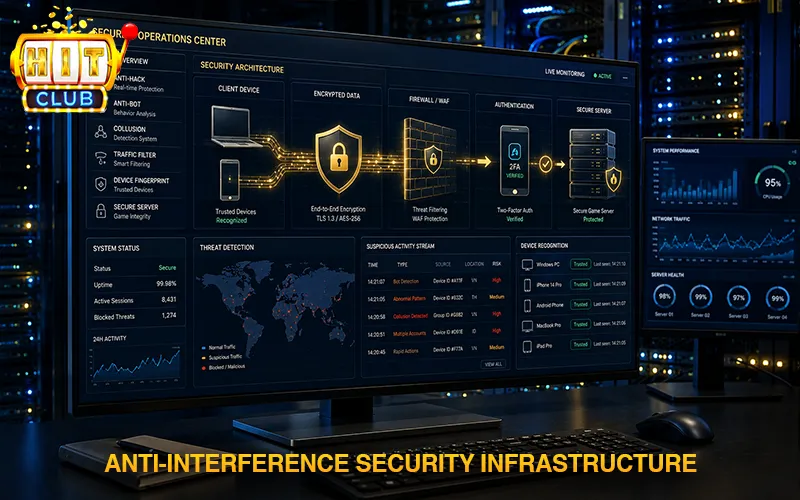
To prevent tools from tampering with application memory or packet sniffing to alter card game outcomes, the operates a multi-layered defense from Client to Server.
Data encryption
- Protocol: All data transmitted between the user application and the central server is encrypted via SSL 256-Bit / TLS 1.3 protocols.
- Practical effect: Eliminates the risk of Man-in-the-Middle (MITM) attacks. Thanks to the intervention of the software system, even if data packets are intercepted in transit, perpetrators cannot decrypt them to read opponent cards or tamper with outgoing commands.
Access control and waf firewall
- Multi-layered defense: Uses a Web Application Firewall (WAF) combined with Cloudflare Magic Transit solutions to classify and filter network traffic.
- Practical effect: Prevents Distributed Denial of Service (DDoS) attacks or automated Botnets from generating fake traffic that disrupts the server. This helps the anti-hack/anti-collusion software system maintain a stable Concurrent Users (CCU) metric, avoiding lag that bad actors could exploit to hijack match control.
Device fingerprinting & 2fa
- Mechanism: The system generates a unique identifier based on the hardware device, MAC address, and user configuration settings.
- Automated response: When detecting logins from unfamiliar devices or abnormal IP range changes across countries, the software system automatically triggers “Protection Lock” mode and requires verification via Telegram OTP or Google Authenticator (2FA).
Anti-collusion algorithms in the anti-hack/anti-collusion software system
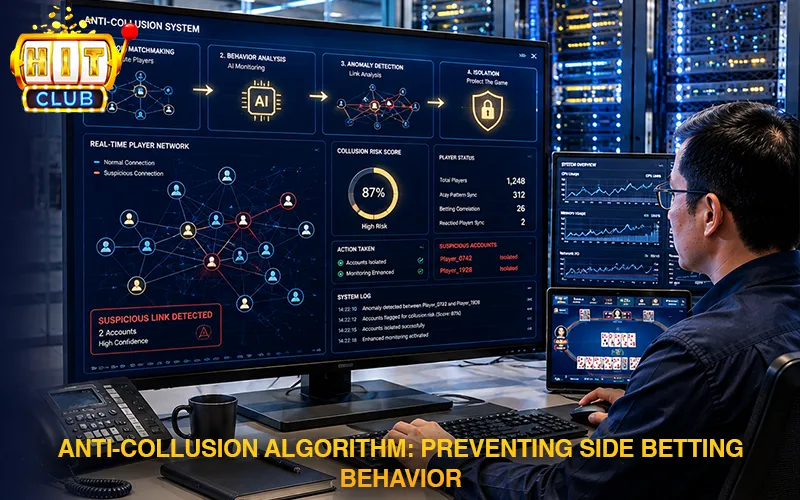
Unlike software hacks, “collusion” occurs when 2 or more real players pair up (via Zalo, Discord, voice calls…) to share card information and disadvantage the remaining players at the table. This is the hardest problem for any PvP gambling portal. The anti-hack/anti-collusion software system addresses this issue by combining random Matchmaking and AI behavioral analysis models.
Operating diagram of the software system:
[Real-time hand data]
│
▼
[Random Matchmaking filter] ──► Prevents table selection/sitting next to familiar accounts
│
▼
[AI Behavioral Audit Engine (Core axis of the anti-hack/anti-collusion software system)]
├── Checks duplicate IP ranges / Device Fingerprints
├── Analyzes joint play frequency & cross Win/Loss ratios
└── Compares Card playing Patterns (Abnormal Fold/Raise)
│
▼
[Suspicion detected] ──► Flagging (Risk Alert) ──► Isolate account & Freeze balance
Smart matchmaking
- Principle: In standard gaming halls, the anti-hack/anti-collusion software system completely removes the self-selection of tables or seating positions.
- Practical effect: Players are assigned to tables purely at random based on their bet levels. This breaks the coordinated timing scenarios used by fraudulent groups to join the same table.
Behavioral pattern analytics using ai
The AI system does not interfere with card dealing results, but continuously scans server logs to identify anomalies based on specific metrics:
- Co-Presence density: The frequency of 2 or more accounts sitting at the same table exceeds random statistical thresholds.
- Chip dumping: Identifies hands where points are intentionally thrown, unreasonable folding occurs, or abnormal raises are made to force the 3rd player to fold.
- Decision-making patterns: Response time consistency down to the millisecond – a signal that the anti-hack/anti-collusion software system uses to detect automated scripts or bots.
Transparent audit via replay id and server logs
Every card game hand generates a unique Replay ID accompanied by a real-time Hash upon completion. If players suspect collusion, the software system supports the Technical team in extracting complete server logs to audit card history and issue refund rulings if fraudulent indicators are verified.
Technical limitations & recommendations for players
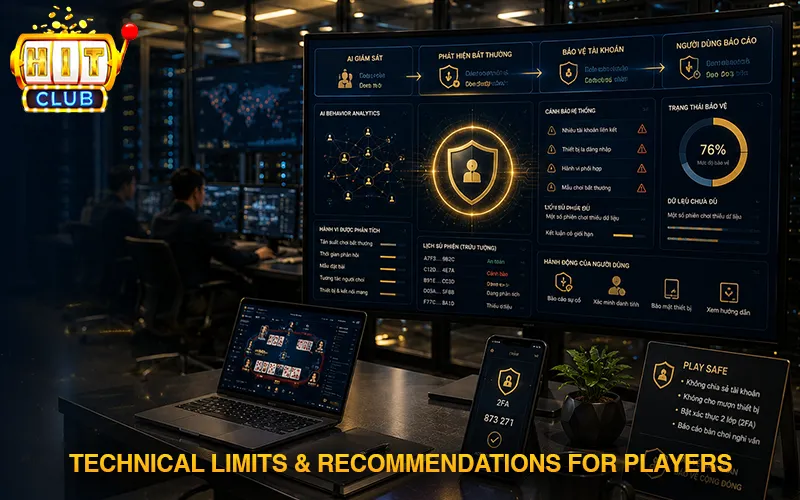
According to updated news on Hitclub, from a cybersecurity technical perspective, no anti-hack/anti-collusion software system is 100% absolute. The fight against fraud is an ongoing update process.
Technology limitations
External sophisticated collusion: If fraudulent groups use external communication channels (phone calls, voice chat) and intentionally play smoothly like normal players to bypass the AI, the anti-hack/anti-collusion software system will require more data accumulation time to detect anomalies.
User coordination responsibilities
To protect personal assets and coordinate effectively with the anti-hack/anti-collusion software system, users should adhere to:
- Do not share accounts: Do not share devices or accounts with others to prevent the AI from recording duplicate Device Fingerprints.
- Enable 2FA immediately upon registration: Protect personal account layers from brute-force password scanning risks.
- Report suspicions via replay ID: When encountering tables with signs of collusion, players should proactively save the Hand ID (Replay ID) and submit it to Customer Support to trigger a manual audit process.
>>See more: Probability Mindset in Modern Poker when Betting Online
Conclusion
The anti-hack/anti-collusion software system at Hitclub operates based on the combination of infrastructure encryption (SSL/WAF) and deep behavioral processing (AI Anti-Collusion). Publicly disclosing the operating mechanisms of the software system alongside its technical limitations demonstrates a commitment to transparency, placing fair player experience at the core of sustainable operations.